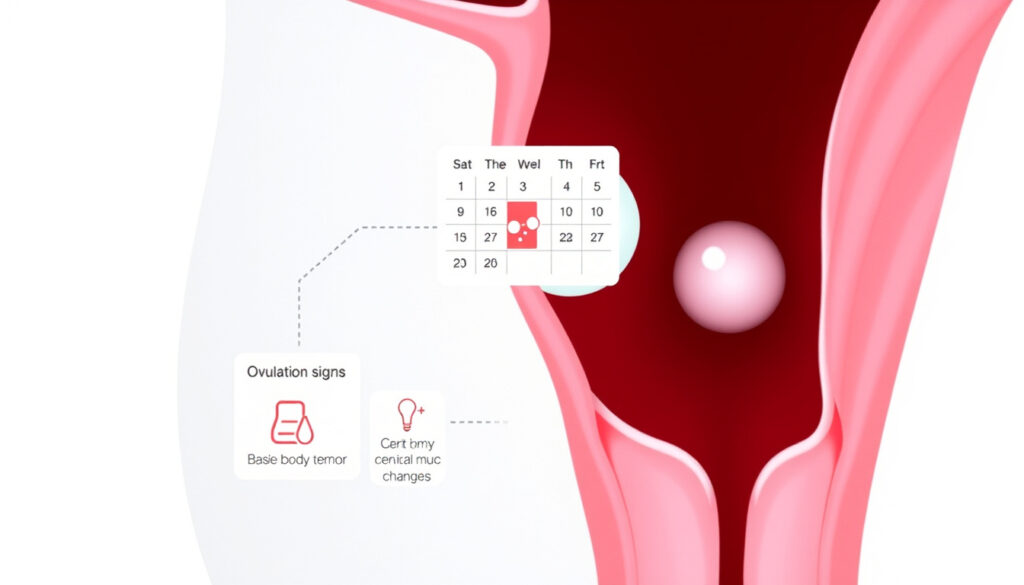
When Does Ovulation Occur? Timing, Signs & Cycle Lengths
Pinpointing your most fertile days often feels like a guessing game, but your body follows a biological clock that shifts based on cycle length, age, and other factors. This guide walks through the science of ovulation timing, the signs to look for, and how your cycle length changes the math.
Ovulation typically occurs 14 days before your next period — Cleveland Clinic ·
In a 28-day cycle, ovulation usually happens around day 14 — Better Health Channel ·
Ovulation lasts 12–24 hours — Clearblue ·
Fertile window spans 6 days (5 days before ovulation plus ovulation day) — Cleveland Clinic ·
Over 90% of eggs are lost by age 30 — NIH study
Quick snapshot
- Ovulation occurs about 14 days before your next period (HealthPartners)
- In a 28-day cycle, ovulation is around day 14 (HealthPartners)
- Once released, the egg is fertile for 12–24 hours (HealthPartners)
- Day 1–5: Menstruation (HealthPartners)
- Day 6–14: Follicular phase — egg matures (HealthPartners)
- Day 14 (approx.): Ovulation — egg released (HealthPartners)
- Day 15–28: Luteal phase — uterus prepares (HealthPartners)
- Fertile window: 6 days (5 days before + ovulation day) (Cleveland Clinic)
- Highest pregnancy probability: 2 days before ovulation (Cleveland Clinic)
- LH surge 24–36 hours before ovulation (Clearblue)
Five quick facts that paint the full ovulation picture:
Here is the data compiled from leading sources:
| Factor | Value |
|---|---|
| Average ovulation day (28-day cycle) | Day 14 |
| Ovulation duration | 12–24 hours |
| Fertile window | 6 days (5 days before + ovulation day) |
| LH surge timing | 24–36 hours before ovulation |
| Egg reserve decline | 90% of eggs lost by age 30 |
How many days after your period do you usually ovulate?
Understanding the follicular phase
- The follicular phase starts on day 1 of your period and lasts until ovulation. Its length varies the most — anywhere from 10 to 20 days in a typical cycle (HealthPartners).
- During this phase, the pituitary gland releases follicle-stimulating hormone (FSH), which stimulates the ovaries to grow a follicle containing an egg (NIH study).
- As estrogen rises, the lining of the uterus thickens in preparation for a possible pregnancy (Better Health Channel).
Ovulation day calculation
- The rule: ovulation occurs about 14 days before your next period, regardless of cycle length (HealthPartners).
- For a 28‑day cycle, that gives day 14. For a longer cycle, add the extra days: a 32‑day cycle pushes ovulation to day 18. For a 21‑day cycle, ovulation lands around day 7 (HealthPartners).
- But ovulation can happen as early as day 6 or as late as day 20 after your period starts, depending on cycle length (HealthPartners).
The 14‑day rule is a guide, not a guarantee. A woman with irregular cycles may ovulate much earlier or later than textbook predictions, which is why tracking multiple signs matters more than relying on calendar counting alone.
How do you tell if you’re ovulating?
Physical symptoms of ovulation
- Cervical mucus becomes clear, slippery, and stretchy — like raw egg white — during the fertile window (HealthPartners).
- Basal body temperature (BBT) rises about 0.2–0.4°C after ovulation and stays elevated until your next period (Clearblue).
- Some women report a mild twinge or cramping on one side — called mittelschmerz — around the time of egg release (Better Health Channel).
- Other possible signs: breast tenderness, bloating, increased sex drive, and light spotting (Cleveland Clinic).
Using ovulation predictor kits
- OPKs detect the luteinizing hormone (LH) surge that occurs 24–36 hours before ovulation (Clearblue).
- Testing with a urine stick once daily starting a few days before your expected ovulation window gives the best results (HealthPartners).
- For irregular cycles, start testing after your period ends and continue until you get a positive, which can take weeks (NIH study).
Cervical mucus changes
- As ovulation approaches, estrogen causes the cervix to produce more watery mucus that helps sperm swim (Cleveland Clinic).
- After ovulation, progesterone thickens mucus into a sticky or creamy consistency, making it harder for sperm to pass (HealthPartners).
- Checking mucus daily and noting its texture is one of the oldest and most reliable fertility awareness methods (Better Health Channel).
OPKs don’t confirm ovulation happened — they just predict an LH surge. Some women have multiple surges without ovulating. Pairing OPKs with BBT charting gives a more reliable “ovulation confirmed” signal.
The implication: combining at least two tracking methods improves your accuracy significantly over relying on a single sign.
Can a female feel when she’s ovulating?
Mittelschmerz: ovulation pain
- Mittelschmerz is a sharp or cramping pain in the lower abdomen that may last minutes to hours (HealthPartners).
- It occurs when the follicle stretches the surface of the ovary before the egg pops out, sometimes with a small amount of fluid or blood (NIH study).
- Pain can alternate sides each cycle, but for some women it’s consistently on one side (HealthPartners).
Other sensations during ovulation
- Some women report a brief “pop” or twinge at the exact moment of follicle rupture (Better Health Channel).
- Increased libido and sharper sense of smell are also reported, likely driven by the estrogen peak (Cleveland Clinic).
- But most women do not feel ovulation at all — particularly if they have a high pain threshold or if the event happens without inflammation (NIH study).
When does ovulation occur in different cycle lengths?
Ovulation in 28-day cycles
- Classic textbook cycle: ovulation on day 14, but in reality it can vary between day 11 and day 17 even among “regular” women (NIH study).
Ovulation in 30-32 day cycles
- Luteal phase stays constant at ~14 days, so the follicular phase lengthens. For a 32‑day cycle, ovulation lands around day 18 (HealthPartners).
Ovulation in 21-day cycles
- With a 14‑day luteal phase, that leaves only 7 days for the follicular phase — ovulation on day 7 (HealthPartners).
Variation by cycle length:
Here is how ovulation day shifts with total cycle length:
| Cycle length | Estimated ovulation day |
|---|---|
| 21 days | Day 7 |
| 28 days | Day 14 |
| 32 days | Day 18 |
| 35 days | Day 21 |
The implication: If you have a longer cycle, your fertile window shifts later. Relying on “day 14” as a universal target will cause you to miss timing entirely.
How does age affect ovulation?
Egg reserve and age
- A female is born with about 1–2 million eggs. By age 30, over 90% are already gone (NIH study).
- By age 40, only about 3% of the original reserve remains (NIH study).
- Older eggs are also more likely to have chromosomal abnormalities, increasing miscarriage risk (Better Health Channel).
Fertility decline timeline
- Fertility starts to decrease noticeably after age 32, then drops more steeply after 37 (Cleveland Clinic).
- Ovulation becomes less regular in the years leading up to menopause — cycles may shorten or lengthen unpredictably (NIH study).
- By the mid‑40s, natural conception rates drop below 5% per cycle (HealthPartners).
Age doesn’t just shrink the egg count — it shortens the window you have each cycle to catch ovulation, because cycles become more variable. A woman in her late 30s may need to track more data for longer each month to spot her fertile days.
Steps to track your ovulation
- Choose a tracking method — BBT thermometer, OPK strips, or a fertility app. Many women combine two for accuracy.
- Start on day 1 of your period — mark the first day of full flow as cycle day 1.
- Record cervical mucus daily — note the color, consistency, and stretchiness. The egg‑white texture signals peak fertility.
- Take BBT every morning — before getting out of bed, at the same time ±30 minutes. A sustained rise confirms ovulation happened.
- Begin OPK testing 3–5 days before your expected ovulation — for a 28‑day cycle, start around day 10. Test once daily and watch for a positive line.
- Look for mittelschmerz — if you feel a twinge on one side, note it. It’s a helpful extra clue.
- Chart everything in one place — an app or paper chart helps you spot patterns over 2–3 cycles.
What we know — and what’s still uncertain
Confirmed facts
- Ovulation occurs about 14 days before next period
- Ovulation signs (cervical mucus, BBT, LH surge) are reliable indicators
- Luteal phase is relatively constant at 14 days
What’s unclear
- Exact day of ovulation can vary cycle to cycle
- Not all women experience noticeable symptoms
- Cycle irregularity makes prediction less accurate
Ovulation typically occurs around day 14 for a 28-day cycle.
— Cleveland Clinic
Ovulation usually happens once each month, about two weeks before your next period.
— Better Health Channel (Victoria Government)
You can only become pregnant if a sperm fertilises an egg. Ovulation usually happens 12 to 16 days before your next period starts.
— Clearblue
For anyone trying to conceive, the takeaway is direct: ovulation timing isn’t a fixed calendar date — it’s a window shaped by your unique cycle length and age. The best strategy is to combine at least two tracking methods for a few cycles. If you’re over 35 and have been trying for six months without success, a fertility specialist can help rule out ovulation problems. For women under 35, the advice is simpler: track consistently, and give your body time.
hopkinsmedicine.org, womenshealth.gov, yourfertility.org.au, tommys.org, webmd.com
Frequently asked questions
Can you ovulate without having a period?
Yes – it’s possible to ovulate before your first postpartum period or in early perimenopause. Ovulation can happen without subsequent bleeding if the uterine lining is insufficient (NIH study).
Does stress delay ovulation?
Yes – high physical or emotional stress can suppress the hypothalamic-pituitary-ovarian axis, delaying or even preventing ovulation (HealthPartners).
Can birth control pills stop ovulation permanently?
No – ovulation typically returns within a few weeks after stopping hormonal contraception, though it may take a couple of cycles to regulate (Cleveland Clinic).
What if my cycle is irregular — can I still predict ovulation?
Yes – but you’ll need more intensive tracking. BBT combined with OPKs gives the best heads‑up, and a fertility specialist can run blood tests or ultrasounds to time ovulation precisely (Better Health Channel).
How long after ovulation does the egg remain fertile?
12–24 hours. If fertilization doesn’t occur within that window, the egg disintegrates and the body prepares for the next cycle (HealthPartners).
Can you ovulate twice in one cycle?
No – only one ovulation event per cycle is typical, though two eggs can occasionally be released within the same 24‑hour window (that’s how fraternal twins happen). A second ovulation later in the same cycle is extremely rare (NIH study).
Meer gerelateerde berichten
 Canadian Dental Care Plan 2026-2027: Renewal Guide & Deadlines
 Griselda Blanco: Separating Fact from Netflix Fiction
 Richard Dreyfuss: Bipolar Disorder and Hollywood Hiatus
 Guru Nanak Dev Ji Birthday 2025 – Date, History, Celebrations
 A Tree Grows in Brooklyn – Genre, Facts and History
 Mark Ballas: DWTS Champion, Accent and Ethnicity
 Chloe Fineman: Religion, Ethnicity, Elon Musk Incident, and More
 Translate From English to Arabic – Best Free Tools 2025
