In the Tall Grass – Plot, Ending and Origins Explained
Vincenzo Natali’s 2019 Netflix adaptation of the Stephen King and Joe Hill novella traps viewers in a disorienting maze where time folds in on itself and redemption comes at a terrible price. The film follows siblings Becky and Cal DeMuth as they investigate a child’s cry echoing from an endless field of grass beside a rural Kansas church, only to discover that some doors, once entered, never let you leave.
Released in October 2019, In the Tall Grass expands the 60-page source material into a 101-minute exploration of cyclical horror, featuring practical effects that render the grass itself as a predatory entity. The narrative weaves together multiple timelines and perspectives, creating a purgatorial puzzle that has sparked extensive debate regarding its temporal mechanics and philosophical implications.
The production marks a rare collaboration between King and his son Hill, brought to screen by the director known for geometric horror in Cube. While critics delivered mixed verdicts on its narrative coherence, the film’s visual atmosphere and Peter Stormare’s unsettling performance as Ross Humboldt have sustained its presence in horror streaming catalogs into 2024.
What Is In the Tall Grass About?
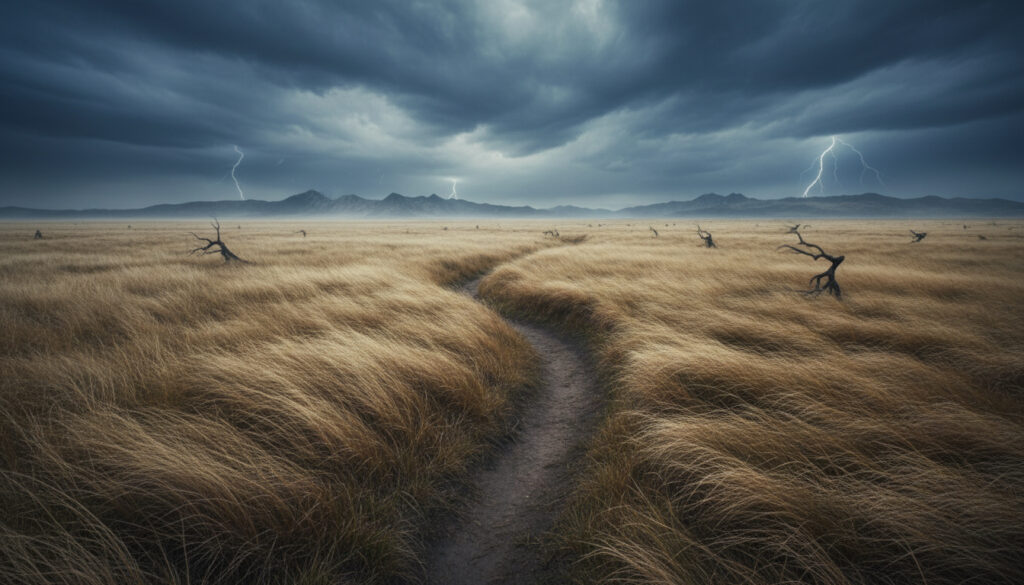
The narrative centers on Becky DeMuth, who is six months pregnant, and her brother Cal traveling to San Diego when they stop beside a decaying church in rural Kansas. A young boy’s voice crying for help draws them into a vast field of tall grass, where they encounter the Humboldt family—Ross, Natalie, their son Tobin, and infant Ginny—similarly trapped. The vegetation exhibits impossible properties, distorting space and time until paths loop back on themselves and voices emanate from impossible directions.
- The grass functions as a purgatorial trap where temporal mechanics allow characters from different time periods to interact
- A mysterious black rock at the field’s center serves as the nexus of the horror, granting knowledge while corrupting those who touch it
- The adaptation significantly alters the novella’s conclusion, introducing a redemption arc absent from the source material
- Filming utilized Ontario locations to substitute for Kansas, emphasizing practical effects over CGI for the grass labyrinth
- Critical reception trended mixed, with Rotten Tomatoes scores near 45% and IMDb ratings averaging 5.4/10
- The narrative explores themes of sin, particularly regarding Becky’s pregnancy and her ex-boyfriend Travis’s prior pressure regarding abortion
| Genre | Horror / Supernatural Thriller |
|---|---|
| Platform | Netflix |
| Content Rating | TV-MA |
| Directed by | Vincenzo Natali |
| Written by | Vincenzo Natali & Patrick Whitley |
| Based on | “In the Tall Grass” by Stephen King and Joe Hill |
| Lead Cast | Laysla De Oliveira, Avery Whitted, Harrison Gilbertson |
| Supporting Cast | Peter Stormare, Rachel Wilson, Tiffany Helena |
| Filming Location | Ontario, Canada (primarily Etobicoke) |
| Production | Netflix Studios |
| Release | October 4, 2019 |
| Runtime | 101 minutes |
The source material originally appeared in the June 2012 issue of Esquire magazine before being collected in the Full Throttle anthology. Wikipedia’s entry on the film details the expansion of the 60-page novella into feature length, noting Natali’s emphasis on the geometric horror inherent in the grass’s shifting topology.
In the Tall Grass Ending Explained
The film’s conclusion operates on multiple temporal planes simultaneously. Characters do not merely travel through the grass; they enter loops where death is temporary and resurrection immediate, yet each iteration erodes their humanity further. The field acts as a judgment mechanism, assessing entrants for redemptive potential versus corruptible weakness.
The Mechanism of the Time Loops
Temporal displacement manifests immediately upon entry. Becky and Cal arrive days after the Humboldt family, yet their paths cross repeatedly with Travis, who enters searching for Becky weeks later in linear time. The grass compresses these disparate arrivals into a singular, eternal present where the dead regenerate near the black rock, often returning with fragmented memories or violent alterations to their personalities.
The film presents a non-linear purgatory where cause and effect operate independently of chronological order. Characters encounter versions of themselves and others from past and future iterations simultaneously, creating a maze not just of space but of temporal possibility. Looper’s analysis emphasizes that the grass specifically targets individuals carrying guilt or unresolved sin, using the loops as both prison and potential path to redemption.
The Black Rock and Corruption
At the geometric center stands an ancient obsidian monolith that hums with psychic energy. Touching it grants immediate understanding of the grass’s mechanics—the labyrinthine paths, the temporal folds, the method of escape—but exacts a price. Ross Humboldt touches the rock and transforms from frightened father to predatory apostle, understanding that the field requires fresh souls and that he must lure new victims to satisfy it.
Travis’s Sacrifice and the Broken Loop
After killing the corrupted Ross, Travis touches the rock despite warnings from Tobin, accepting the knowledge and the corruption that accompanies it. He utilizes a temporal portal created by the rock to send Tobin back to the church parking lot moments before Becky and Cal’s initial arrival. Tobin carries Becky’s bloodied necklace—dropped during a previous iteration—and uses it as proof of the danger, convincing the siblings to abandon their rescue attempt and drive away. Becky decides to keep her baby, breaking the cycle of despair.
Travis dies as the grass envelops him, redeemed by his self-sacrifice. CBR’s ending breakdown notes that while Becky and Cal escape this iteration, Ross and Natalie remain trapped in eternal loops, their past selves never rescued and the field’s hunger for “sinners” likely unsated.
Is In the Tall Grass Based on a True Story?
The film derives entirely from fictional source material. No documented case corresponds to the supernatural events depicted, nor does Kansas maintain records of disappearances matching the narrative’s specifics. The story represents pure speculative fiction, crafted specifically for the horror anthology market.
The King-Hill Collaboration
Stephen King and his son Joe Hill co-authored the novella, publishing it initially in Esquire magazine in 2012. This collaboration merged King’s expertise in rural American horror with Hill’s contemporary voice, creating a narrative voice distinct from either author’s solo work. The story subsequently appeared in Hill’s collection Full Throttle.
The novella runs approximately 60 pages, providing a lean, relentless narrative without the film’s expanded mythology or additional characters. Screen Rant’s comparison highlights that the literary version contains no Travis character and offers no possibility of escape, ending with Becky consuming her unborn child in a act of unknowing horror, trapped eternally with Tobin luring future victims.
Adaptation Divergences
Natali’s screenplay introduces several significant departures. Travis exists only in the film, providing both a redemption arc and a mechanism for breaking the loop. The time portal and the possibility of warning past selves are cinematic inventions. Refinery29’s analysis contrasts the novella’s unrelenting nihilism with the film’s semi-hopeful conclusion, suggesting the adaptation softens the source material’s darkest implications while adding visual spectacle.
In the Tall Grass Cast and Production
Vincenzo Natali, known for the geometric claustrophobia of Cube (1997), directed and co-wrote the adaptation alongside Patrick Whitley. The production emphasized practical effects, constructing physical sets of towering grass that actors could navigate rather than relying heavily on digital environments.
Principal Performances
Laysla De Oliveira portrays Becky DeMuth with physical intensity, conveying both maternal determination and existential terror. Avery Whitted plays her brother Cal, whose protective instincts gradually warp under the grass’s influence. Harrison Gilbertson appears as Travis McKean, Becky’s ex-boyfriend whose search for her drives the latter half of the narrative.
Peter Stormare delivers a standout performance as Ross Humboldt, transforming from concerned father to malevolent entity. Rachel Wilson portrays the Humboldts’ son Tobin, while Tiffany Helena appears as Natalie Humboldt. The ensemble maintains naturalistic performances despite the increasingly surreal circumstances, grounding the supernatural elements in human desperation.
Production Design and Location
Despite the Kansas setting, filming occurred primarily in Ontario, Canada, specifically in Etobicoke and surrounding rural areas where fields could be modified to suggest the American Midwest. No scenes were shot on location in Kansas. Nerdist’s production coverage details the challenges of shooting in practical grass environments, where maintaining continuity proved as disorienting for the crew as for the characters. Voor meer informatie over de plot, het einde en de oorsprong van In the Tall Grass, kun je de Michael B. Jordan biografie lezen. Michael B. Jordan biografie
The film contains graphic scenes of body horror, including miscarriage imagery and cannibalistic undertones. The TV-MA rating reflects sustained terror, violence, and disturbing thematic content regarding familial corruption and temporal disorientation.
The practical effects team engineered grass sections on hydraulic platforms that could shift and reconfigure, creating the illusion of a living labyrinth without post-production manipulation. This approach demanded complex choreography from the cast, who navigated blind pathways while maintaining spatial awareness of camera positions.
For viewers interested in similar atmospheric horror examining familial dissolution, The Dark and the Wicked – Plot, Ending, Cast Explained offers a complementary exploration of isolation and supernatural threat.
Development and Release Timeline
- : Stephen King and Joe Hill’s novella “In the Tall Grass” published in Esquire magazine.
- : Novella collected in Joe Hill’s anthology Full Throttle.
- : Netflix greenlights adaptation with Vincenzo Natali attached as director.
- : Principal photography begins in Ontario, Canada.
- : Filming concludes after six months of production.
- : World premiere at Fantastic Fest in Austin, Texas.
- : Global Netflix release.
Separating Fact from Theoretical Interpretation
While the film presents concrete narrative events, certain elements remain deliberately ambiguous, inviting viewer interpretation while maintaining specific established truths.
Established Information
- The production is fictional, with no basis in documented events or Kansas state records
- Vincenzo Natali directed and co-wrote the 2019 Netflix release
- The source material is a 2012 novella by Stephen King and Joe Hill
- Filming occurred in Ontario, Canada, not Kansas
- The grass exhibits temporal manipulation properties within the narrative
- Ross Humboldt transforms into an antagonist after contact with the black rock
Uncertain or Ambiguous Elements
- The origin or nature of the black rock remains unexplained
- Whether the time loop is fully broken or merely paused for Becky and Cal
- The ultimate fate of Ross and Natalie Humboldt—whether they persist in alternate loops
- The grass’s criteria for selecting victims or “sinners”
- Whether Travis’s assimilation into the grass represents salvation or eternal imprisonment
- The extent of the grass’s geographic reach or if other such fields exist
Thematic Significance and Symbolic Architecture
The narrative operates as a meditation on inescapable consequences. The grass literalizes the concept of purgatory—a transitional state where souls undergo trials to determine their ultimate fate. Each character enters carrying specific guilt: Becky faces an unplanned pregnancy complicated by Travis’s previous insistence on termination; Cal harbors resentment regarding his sister’s situation; Ross enters as a failed protector.
The black rock serves as both confessional and judge, offering perfect knowledge at the cost of humanity. Those who accept its touch, like Ross, become instruments of the field’s will, tasked with perpetuating the cycle of entrapment. This mechanism suggests the grass functions not merely as a predator but as a testing ground, separating those capable of self-sacrifice from those who succumb to corruption.
Temporal distortion reinforces themes of regret and the inability to alter past mistakes. Characters encounter versions of themselves and others at different decision points, forced to witness the consequences of choices already made. Only through Travis’s final act—accepting death to enable Becky’s escape—does the loop fracture, suggesting redemption requires absolute selflessness rather than mere survival.
Critical Reception and Primary Sources
Contemporary reviews aggregated to approximately 45% on Rotten Tomatoes and 5.4/10 on IMDb upon release, with critics citing pacing issues and occasionally muddled lore as primary weaknesses. However, assessments consistently praised the atmospheric dread and Stormare’s committed performance.
The adaptation draws primary inspiration from the King-Hill novella, originally published in Esquire and later collected in Full Throttle. Natali’s expansion of the source material introduces the Travis character and the temporal portal mechanics not present in the literary version, which maintains a relentless, inescapable tone throughout.
Final Assessment: Is In the Tall Grass Worth Watching?
The film succeeds as a visually immersive horror experience, leveraging practical effects and strong performances—particularly from De Oliveira and Stormare—to overcome narrative complexity. While the time-loop mechanics may confuse viewers seeking straightforward storytelling, the thematic weight regarding redemption and consequence provides sufficient intellectual engagement. For audiences appreciating the King-Hill collaborative style or Natali’s geometric approach to horror, the production offers a distinct, if divisive, entry in the Netflix horror catalog. Those seeking similarly atmospheric explorations of familial horror in isolated settings may find value in The Dark and the Wicked – Plot, Ending, Cast Explained.
Frequently Asked Questions
Where can I watch In the Tall Grass in 2024?
The film remains available exclusively on Netflix as of 2024, though regional availability depends on current licensing agreements. Subscribers should verify local catalog status, as streaming rights occasionally shift.
How does the movie differ from the Stephen King novella?
The film introduces Travis, creates a possible escape through the time portal, and offers a semi-hopeful ending. The novella traps characters eternally, features no Travis, and concludes with Becky unknowingly consuming her fetus, maintaining unrelenting horror without redemption.
What does the ending of In the Tall Grass really mean?
The ending suggests Travis achieves redemption through self-sacrifice, breaking the loop for Becky and Cal by sending Tobin back to warn them. However, Ross and Natalie likely remain trapped, and the grass’s hunger for victims presumably continues, indicating the escape may be partial or temporary.
Where was In the Tall Grass actually filmed?
Production occurred entirely in Ontario, Canada, primarily in Etobicoke and surrounding rural areas. Despite the Kansas setting, no filming took place in the United States.
Is the grass in the movie real or CGI?
The production utilized practical sets with physical grass planted on hydraulic platforms that could shift and reconfigure. This practical approach minimized CGI, creating authentic spatial disorientation for the cast.
Who survives at the end of In the Tall Grass?
Becky and Cal survive after Tobin warns them away from entering the field. Travis dies, absorbed by the grass after sending Tobin back. Ross and Natalie Humboldt remain trapped in the time loops, their fates unresolved.
Meer gerelateerde berichten
 Best Smoothie Recipes for Weight Loss – Top 5 Low-Calorie Picks
 Roxane Bruneau: Life, Music, Awards and 2026 Tour
 Mos Def Biography: Career, Net Worth, and Children
 TSX Index Live: S&P/TSX Composite Price, Chart & News
 New Balance Rebel v5 – Review, v4 Comparison, Verdict
 Mike McDaniel: Sobriety, Ethnicity, Wife, and Career Facts
 Jordan Peterson: Beliefs, Health, and Politics Explained
 George Kennedy: Life, Career, Death & Net Worth
