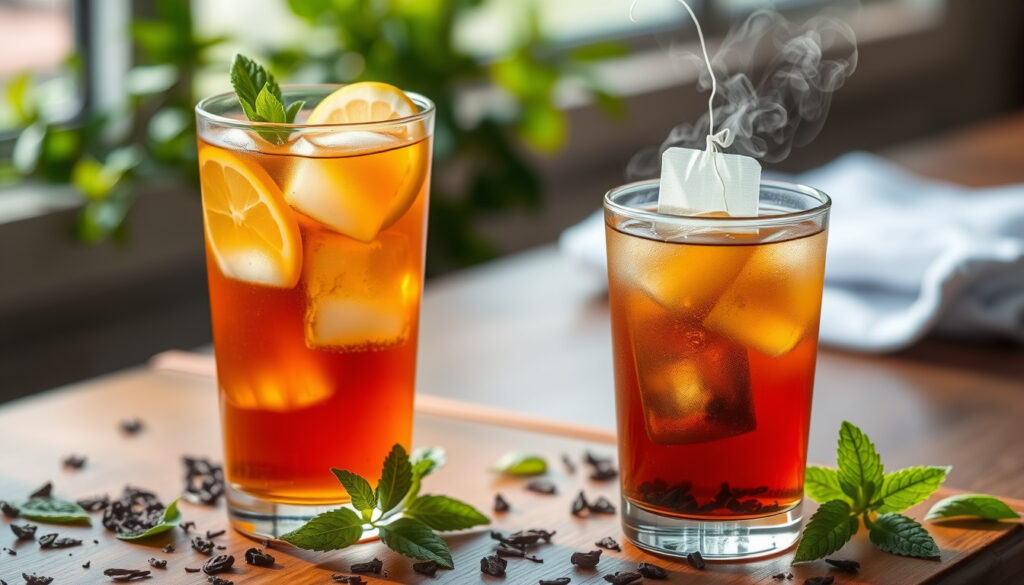
Ice Tea vs Iced Tea: Differences, Recipes, and Health Facts
There’s a reason so many homemade iced tea recipes promise “not bitter”—because bitterness is the most common complaint. The good news is that with a few science-backed adjustments, you can make a glass that’s smooth, flavorful, and actually good for you.
Origin of iced tea: First recorded in the 1860s (Wikipedia) · Sugar in bottled iced tea (12 oz): Up to 30 g (NHLBI) · Optimal steeping time (black tea): 3–5 minutes (Consumer Reports)
Quick snapshot
- Iced tea is a cold tea beverage served with ice (Wikipedia)
- Commercial iced tea often contains high sugar (Consumer Reports)
- Over-steeping black tea produces bitterness (ScienceInsights)
- Exact year of iced tea’s first invention (multiple claims) (Wikipedia)
- Whether the spelling “ice tea” predates “iced tea” (Wikipedia)
- First recorded iced tea: 1860s, United States (Wikipedia)
- Modern bottled iced tea boom: late 20th century (Wikipedia)
Here is the core data on iced tea’s origins, consumption, and sugar load.
| Fact | Details |
|---|---|
| First recorded iced tea | 1860s, United States |
| US iced tea consumption share | 80% of all tea |
| Average sugar in bottled iced tea (12 oz) | 30 grams |
| Recommended steep time for black tea | 3–5 minutes |
What Exactly Is Ice Tea?
Is iced tea literally just cold tea?
Yes, but the process matters. Iced tea is brewed tea—typically black, green, or herbal—that is cooled and served over ice. It can be made by brewing hot tea and then chilling it, or by cold-steeping tea leaves in cold water. The Wikipedia entry on iced tea (the collaborative encyclopedia) notes that the drink dates back to the 1860s in the United States, though iced tea became widely popular after the 1904 St. Louis World’s Fair.
Key ingredients in classic iced tea
- Base tea: Black tea is most common, but green, white, and herbal teas work.
- Water: Filtered water improves taste (Consumer Reports, the consumer advocacy organization).
- Sweetener (optional): Sugar, honey, or syrups are added while tea is warm for best dissolution.
- Ice: Large cubes dilute less than small ones.
Homemade iced tea lets you control sugar and quality. The catch: bottled tea’s convenience comes at a nutritional cost—up to 30 grams of sugar per serving, according to NHLBI (the National Heart, Lung, and Blood Institute).
The implication: the choice between homemade and bottled is a direct trade-off between time and health.
Is There a Difference Between Ice Tea and Iced Tea?
Spelling variations and regional usage
Both “ice tea” and “iced tea” refer to the same beverage. “Ice tea” is a common variant spelling, especially in the United States, where it appears on menus and product labels. The Wikipedia entry notes that the two terms are used interchangeably, with no difference in preparation or ingredients. Linguistically, “iced tea” is the standard form, but “ice tea” is widely accepted.
Does the term affect the drink itself?
No. Whether you order “ice tea” or “iced tea,” you’ll get the same cold, tea-based drink. The spelling is a matter of regional preference, not a different recipe. So if you’re wondering is there a difference between ice tea and iced tea—the answer is purely orthographic.
The pattern: “Ice tea” and “iced tea” are identical beverages. The spelling difference has zero impact on flavor, health, or preparation.
How to Make the Perfect Homemade Iced Tea
What is the secret to making good iced tea?
The secret is temperature control and timing. Over-steeping extracts tannins, which cause bitterness. Under-steeping leaves the tea weak. Consumer Reports (the nonprofit product testing organization) recommends steeping black tea for about 5 minutes at 200°F, then cooling it in the refrigerator. AARP (the membership organization for older Americans) suggests using double tea bags for hot-brewed iced tea to compensate for dilution from ice.
How to brew the best iced tea according to experts
Both hot-brewing and cold-brewing produce excellent results. BBC Good Food (the trusted UK recipe publisher) recommends steeping 8 tea bags in 2 quarts of boiling water for 5 minutes, then removing the bags and chilling. For cold brew, Consumer Reports says to steep tea in cold water in the refrigerator for about 2 hours, while AARP recommends 6 to 8 hours for a fuller flavor.
Step-by-step hot brew and cold brew methods
Three methods, one pattern: control temperature to avoid bitterness.
- Hot brew: Bring 4 cups filtered water to 200°F. Steep 4–6 tea bags for 3–5 minutes. Remove bags, add sweetener if desired, cool to room temperature, then refrigerate. Serve over ice.
- Cold brew: Place 4–6 tea bags in a pitcher with 4 cups cold water. Refrigerate 6–8 hours. Remove bags, sweeten if desired, and serve over ice. Cold brew yields a smoother, less bitter tea because fewer tannins extract at low temperatures (ScienceInsights, a science communication platform).
- Sun tea (not recommended): Steeping in direct sunlight can promote bacterial growth. Stick to refrigerator or stove methods.
The pattern: choose hot brew for speed, cold brew for smoothness, and skip sun tea entirely.
What Are Common Iced Tea Mistakes?
Over-steeping leading to bitter taste
Steeping black tea longer than 5 minutes extracts too many tannins, creating a harsh, astringent flavor. ScienceInsights notes that keeping steeping time to 3–5 minutes helps extract beneficial compounds without bitterness. For green tea, use water at 175°F and steep only 2 minutes.
Using boiling water for delicate teas
Boiling water (212°F) scorches green and white teas, releasing bitterness. The ideal temperature range is 170–185°F for green tea and 160–170°F for white tea. Consumer Reports advises using a thermometer or letting boiled water cool for 1–2 minutes before steeping delicate teas.
Adding ice too early causing watery drink
Pouring hot tea directly over ice melts the ice instantly, diluting the flavor. The fix: cool the tea to room temperature or refrigerate it before pouring over ice. AARP recommends using double-strength tea (double the tea bags) to counteract dilution even when you add ice.
A single mistake—over-steeping or using the wrong water temperature—can turn a healthy drink into a bitter disappointment. Mastering these basics means you can enjoy iced tea without added sugar and without the bitterness that drives people to bottled versions.
Is Iced Tea Good or Bad for You?
Iced tea health benefits: antioxidants and hydration
Unsweetened iced tea is rich in polyphenols, particularly catechins and flavonoids, which are linked to reduced inflammation and lower risk of heart disease. Consumer Reports states that freshly made iced tea can offer many of the same health benefits as hot tea, including potential support for cardiovascular health and lower risk of cognitive decline and diabetes. The key is to avoid adding sugar.
Who should not drink ice tea?
People prone to kidney stones should limit iced tea because tea leaves contain oxalates, which can contribute to calcium oxalate stones. The NHLBI (National Heart, Lung, and Blood Institute) includes iced tea in its sugar shocker list, noting that a 591 mL serving can contain 33 grams of sugar—equivalent to 8 teaspoons. Additionally, Consumer Reports nutritionist Amy Keating warned that bottled iced tea “can contain about as much or more sugar than soda.”
What is the unhealthiest tea to drink?
Sweetened bottled iced tea is among the unhealthiest tea drinks. Ottawa Public Health (the Canadian public health authority) lists iced tea at 591 mL containing 33 g of sugar. Firebelly Tea (a specialty tea brand) reports that canned and bottled teas can contain up to 20 times less polyphenols than freshly brewed tea. So the unhealthiest option is the most processed, sugar-laden commercial version.
Three comparisons, one pattern: homemade vs. store-bought is a trade-off between convenience and nutrition.
Here is the direct comparison between homemade and bottled options.
| Aspect | Homemade iced tea | Store-bought bottled iced tea |
|---|---|---|
| Sugar content | You control it (0–30 g) | Often 30+ g per 12 oz |
| Polyphenol levels | High (freshly brewed) | Up to 20× lower (Firebelly Tea) |
| Cost per serving | $0.15–0.30 | $1.50–3.00 |
Upsides
- Full control over sugar and quality
- Higher antioxidant content when fresh
- Lower cost per serving
- Customizable flavors (herbs, fruits)
Downsides
- Requires time and planning
- Risk of bitterness if brewed incorrectly
- Shorter shelf life (2–3 days refrigerated)
- Convenience of bottled tea is hard to beat
Common Mistakes and How to Fix Them
- Over-steeping: Use a timer. 3–5 minutes for black tea, 2 minutes for green.
- Wrong water temperature: Use a thermometer or let boiling water cool 1–2 minutes for green tea.
- Adding ice too early: Cool tea completely before pouring over ice, or use double-strength brew.
- Using low-quality tea: Choose loose-leaf or high-quality bags for better flavor.
- Not sweetening while warm: Sugar dissolves poorly in cold liquid. Add sweetener to warm tea.
What the Experts Say
“Iced tea is a form of cold tea, often served in a glass with ice. It may be sweetened with sugar, honey, or other sweeteners.”
— Wikipedia entry on iced tea (community-reviewed encyclopedia)
“Bottled iced tea can contain about as much or more sugar than soda.”
— Amy Keating, nutritionist at Consumer Reports
“For the best iced tea, brew double-strength hot tea, then pour it over ice. The extra concentration keeps the flavor bold even as the ice melts.”
— BBC Good Food (trusted UK recipe publisher)
If you’re measuring ingredients, you might find our guide on how many ml in a cup useful for scaling recipes. And for dairy-free iced tea, check out our substitute for heavy cream article.
isitbadforyou.com, divany.hu, thelivinglook.com, prevention.com, eathappynow.com, drink4good.com
Frequently Asked Questions
How long should I steep tea for iced tea?
Black tea: 3–5 minutes at 200°F. Green tea: 2 minutes at 175°F. For cold brew, steep 6–8 hours in the refrigerator.
Can I use green tea for iced tea?
Yes. Green tea makes a lighter, more delicate iced tea. Use cooler water (175°F) and shorter steep time to avoid bitterness.
Is bottled iced tea healthy?
Most bottled iced teas contain 30+ grams of sugar per serving and far fewer polyphenols than fresh-brewed tea. Check labels for added sugar and artificial ingredients.
What sweetener works best for iced tea?
Simple syrup (dissolved sugar) integrates best because it’s already liquid. Honey, agave, or stevia also work well. Add while tea is warm.
Does iced tea have caffeine?
Yes, if made from caffeinated tea leaves. Black tea has about 40–70 mg per 8 oz, green tea about 20–45 mg. Herbal teas are caffeine-free.
How do I make iced tea without bitterness?
Use correct water temperature, don’t over-steep, and cool the tea completely before adding ice. Cold brewing also reduces bitterness.
Can I cold-brew iced tea?
Yes. Place tea bags in cold water and refrigerate 6–8 hours. It produces a smoother, less bitter tea with fewer tannins.
For the average American home cook, the choice is clear: spend 10 minutes brewing a batch of unsweetened iced tea, or spend $2 on a bottle that delivers 30 grams of sugar and minimal antioxidants. The homemade route delivers control over sugar and higher antioxidant content.
Meer gerelateerde berichten
 DeepL Translate French to English: Verified Guide
 Hydro Québec Espace Client: Create & Manage Your Account
 Jamal Murray: Family, Faith, Career & Friendship with Jokic
 Kat Dennings: Age, Husband, Net Worth, Diagnosis, and More
 William Dandjinou: Biography, Height, Olympic Achievements
 New Christmas Movies 2025: Netflix, Prime Video & Disney+ Guide
 Laurent Duvernay-Tardif: NFL Super Bowl Winner to Doctor
