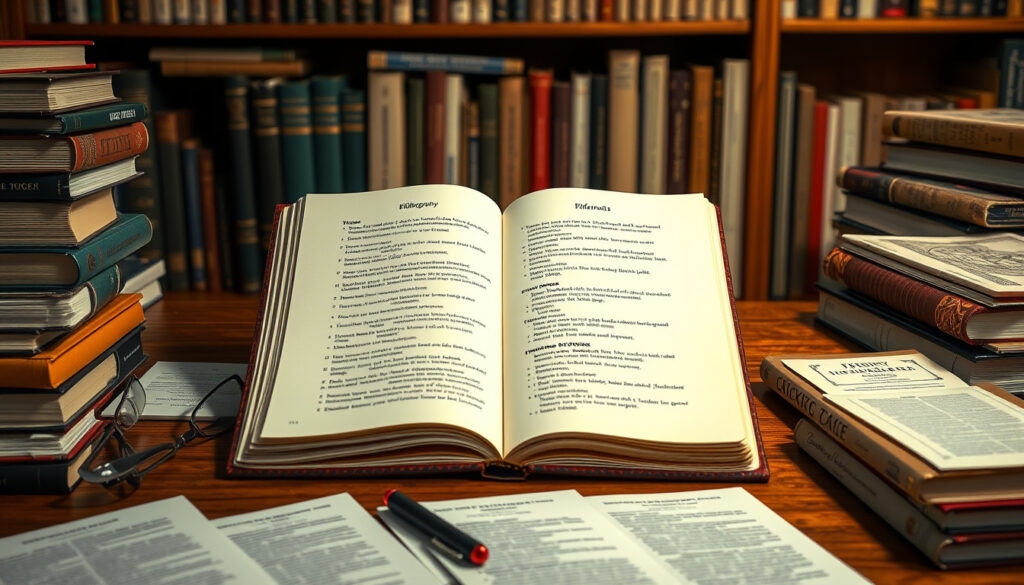
What Is a Bibliography? Definition, Examples & How to Write
Bibliographies trip up students and researchers far more than they should—mostly because the rules shift depending on which style guide your professor or publisher prefers. This guide cuts through the confusion with clear definitions, concrete examples, and a step-by-step process for building a bibliography that holds up to scrutiny.
Core Purpose: List of all sources used or consulted · Common Styles: APA, MLA, Chicago, Harvard, OSCOLA · Key Difference from References: Includes consulted sources, not just cited · Typical Placement: End of document · Entry Requirements: Author, title, publisher, date
Quick snapshot
- Bibliography lists consulted sources per major citation styles (Scribbr)
- Exact OSCOLA requirements without official guide access
- MLA Handbook 9th edition tightened annotated bibliography rules (Purdue OWL)
- Choosing the right style guide early prevents reformatting an entire source list
| Label | Value |
|---|---|
| Standard Definition | List of sources used in academic writing — Adobe |
| Merriam-Webster Meaning | History or list of writings relating to a subject |
| BibGuru Scope | Complete list of consulted and cited sources |
| Placement Norm | End of document — Oxbridge |
| APA Bibliography Name | References |
| MLA Bibliography Name | Works Cited |
| APA Edition | 7th (2020) |
| MLA Edition | 9th (2021) |
What is a bibliography and example?
A bibliography is a complete list of every source you consulted while researching or writing a paper—regardless of whether you quoted, paraphrased, or simply read it. The Adobe academic resource describes it as “a list of all sources that have been used in a piece of academic writing,” while Merriam-Webster frames it as “a list often with descriptive or critical notes of writings relating to a subject.” The key word is consulted: if you read it to understand the topic, it belongs on the list.
Different citation styles give the bibliography different names. In APA (defined in the 7th edition of the Publication Manual, Scribbr), it’s called References. In MLA (9th edition of the MLA Handbook, Scribbr), the equivalent page is called Works Cited. The names differ, but the function is the same.
Definition of a bibliography
At its core, a bibliography entry includes the author’s name, the publication year, the title, the publisher, and—for online sources—the access date or URL. The BibGuru citation tool frames it as a “complete list of the sources that you consulted and cited,” capturing the exhaustive nature of the format. The breadth is what separates a bibliography from a simple reference list.
| Style | Bibliography Name | Discipline Focus |
|---|---|---|
| APA | References | Sciences, Social Sciences |
| MLA | Works Cited | Humanities |
| Chicago | Bibliography | Business, History, Fine Arts |
| Harvard | Reference list | Various |
| OSCOLA | Table of Authorities + Bibliography | Legal |
The implication: different academic fields have settled on different names for the same basic function, which is why checking your assignment’s style sheet matters before you start formatting.
Basic examples
A typical book entry in APA looks like this: Mounier-Kuhn, P. (2020). Title of work. Publisher Name. The same source in MLA reads: Mounier-Kuhn, Pierre. Title of Work. Publisher Name, 2020. Notice the differences: APA uses initials and sentence case; MLA spells out the first name and uses title case.
For a journal article, APA expects: Clinton-Lisell, V. et al. (2020). Title. Journal, 68(4), 221-227. (SCCSC LibGuides) MLA renders it as: Clinton-Lisell, Virginia et al. “Title.” Journal, vol. 68, no. 4, 2020, pp. 221-227. MasterFILE Premier. The MLA version also requires the database name—an element APA omits entirely.
The same source looks noticeably different depending on which style you choose. Spending five minutes checking your style guide upfront saves reformatting an entire list later.
How do I write a bibliography?
Writing a bibliography comes down to three stages: collect every source, format each entry correctly, and arrange them in alphabetical order by the author’s last name. It sounds straightforward, but the formatting details are where mistakes creep in. Purdue OWL provides detailed samples for both MLA and APA annotated bibliography formats.
Steps to create one
- Gather all sources. Go through your notes, research documents, and browser bookmarks. Include everything you read, not just the sources you directly quoted or paraphrased.
- Check your required citation style. Your instructor or publisher specifies the format—APA, MLA, Chicago, Harvard, or OSCOLA. If it wasn’t assigned, ask before you start formatting.
- Format each entry element by element. Place the author’s name in the correct order (Last, Initials for APA; Last, First for MLA). Put the publication year in the right spot. Capitalize the title according to the style (sentence case for APA, title case for MLA).
- Apply the hanging indent. The first line is flush left; subsequent lines are indented half an inch. Both APA and MLA use this standard for their source lists.
- Alphabetize by author last name. Skip articles (a, an, the) when sorting. Move titles to the author’s name slot if there’s no attributed author, sorting by the first major word.
General template
Every bibliography entry follows the same skeleton: Author. (Date). Title. Source information. The specifics change—italics for books and journals versus quotation marks for articles and chapters in MLA, or APA dropping the period after a DOI. Scribbr breaks down these differences in side-by-side comparisons.
The practical layout both styles recommend is 12 pt Times New Roman, double spacing throughout, and one-inch margins on all sides (SMSU Writing Center). These defaults apply to the bibliography page itself and the rest of your document.
How do I format a bibliography?
Formatting a bibliography means mastering the specific rules of your chosen style—things like where the publication date sits, how titles are capitalized, and whether you need a period after a URL. APA Style (the official source from the American Psychological Association) provides an authoritative comparison guide between APA and MLA formats.
APA format
In APA’s References page, author names follow the format Last, Initials (e.g., Mounier-Kuhn, P.). The publication year goes immediately after the author’s name in parentheses. Titles use sentence case—only the first word and proper nouns are capitalized. Articles and book chapters don’t get quotation marks in APA; instead, italicize the journal or book title that contains them. A period never follows a DOI or URL in APA 7th edition.
APA in-text citations use the author-date-page format: (Ghilani, 2017, p. 83) for a quote (SCCSC LibGuides). APA also requires a title page in academic papers—something MLA doesn’t ask for. Lists can include up to 20 authors before truncation.
MLA format
MLA’s Works Cited uses Last, First for author names (Mounier-Kuhn, Pierre), and the publication date appears later in the entry, after the title. Titles use title case—major words capitalized. Articles and chapters get quotation marks; books and journals get italics. A period follows the DOI or URL in MLA 9th.
MLA in-text citations use the author-page format: (Ghilani 83), with no year and no “p.” before the page number (SCCSC LibGuides). The MLA Handbook 9th edition also introduced a tightened rule: annotated bibliography entries require a full one-inch hanging indent for the annotations themselves (Purdue OWL), compared to APA and Chicago’s half-inch standard.
APA puts the date early because science values timeliness—a 1999 study reads differently than a 2024 one. MLA keeps pages visible because literary analysis depends on pinpointing evidence. The structure reflects the discipline’s priorities.
Is a reference the same as a bibliography?
A reference list and a bibliography are closely related but not identical. CW Authors notes that “bibliography generally means list of all sources read; references mean cited sources only.” The bibliography casts a wider net—anything you consulted, even without a direct quote, belongs on it.
Key differences
The practical difference: if you read a source to understand the background of your topic but never quoted or paraphrased it, a reference list skips it, while a bibliography includes it. A reference list is stricter and shorter; a bibliography is comprehensive. Scribbr explains that APA’s “References” and MLA’s “Works Cited” are technically reference lists, though the term bibliography has come to encompass both in common usage.
When to use each
Most undergraduate and graduate assignments ask for a bibliography in the traditional sense—a list of all consulted sources. Some research papers, particularly in sciences, specify only a reference list. When the requirement says “bibliography,” check whether it means “all consulted sources” or “all cited sources.” When in doubt, include more rather than less.
Because APA is typically used in science courses, the date of the information is extremely important. — SCCSC Library Guide
The most obvious difference that you’ll see in an MLA paper and an APA paper is the title of the citation page. — Bibliography.com
Where do I write a bibliography?
The bibliography appears at the end of your document, before any appendices or supplementary materials. Oxbridge Writers confirms the standard placement is the final section before appendices, signaling the end of your documented research. Both APA and MLA place their source lists in this same location.
In essays and research papers
In a standard essay or research paper, the bibliography (or References/Works Cited) is the last major section. It starts on its own page, with the title centered at the top—bold or plain depending on your style guide. MLA uses “Works Cited”; APA uses “References”; Chicago typically says “Bibliography.” The page follows the same formatting as the rest of your document.
In projects and dissertations
Longer academic works like dissertations and theses follow the same end-placement rule, though the source list may be split. Some style guides, particularly OSCOLA for legal writing, distinguish between a “Table of Authorities” (cases and legislation directly cited) and a separate bibliography (all other sources consulted). Scribbr advises checking your institution’s style sheet before you finalize a dissertation’s source list.
Confirmed
- Bibliography lists consulted sources per major citation styles
- APA calls its list “References”; MLA calls its list “Works Cited”
- Both APA and MLA use hanging indent, 12pt TNR, double spacing, 1-inch margins
- MLA 9th edition requires 1-inch indent for annotated bibliography annotations
- APA uses sentence case; MLA uses title case for titles
- Chicago is used by Business, History, and Fine Arts disciplines
Unclear
- Exact OSCOLA bibliography requirements without direct access to the official guide
- Whether annotated bibliography indent rules vary by institution within Chicago style
Related reading: What Is a Tor Browser · Nexus U of W Login Guide
uagc.edu, writing.northwestern.edu, pitt.libguides.com, libguides.unf.edu
Bibliographies form the backbone of academic work by cataloging sources, much like the approaches detailed in this guide to bibliography purpose and types with practical examples.
Frequently asked questions
Does OSCOLA have a bibliography?
OSCOLA (Oxford University Standard for Citation of Legal Authorities) primarily uses a “Table of Authorities” for cases and legislation directly cited, with a separate bibliography for other sources consulted. The exact formatting details require access to the official OSCOLA guide, which legal writers typically obtain through their institution.
Can ChatGPT write an annotated bibliography?
AI tools like ChatGPT can generate formatted entries based on source details you provide, but you must verify every detail independently. AI can hallucinate author names, publication years, or page numbers. Use AI as a formatting aid, not a fact-checker.
Do I need both bibliography and references?
Most assignments specify one or the other. If your style guide uses “References” or “Works Cited,” that’s your source list—don’t create a separate bibliography unless explicitly required. When both are asked for, the bibliography includes all consulted sources and references includes only directly cited ones.
What is a bibliography of a person?
A bibliography of a person lists all works written by a specific author. These are used in literary scholarship and biographical research to map an individual’s publishing history. The format follows standard citation rules but centers on one writer’s output across their career.
What is a bibliography in a presentation?
A presentation bibliography lists the sources consulted for slide content, data, or images. It typically appears on a final “References” or “Sources” slide. The same formatting rules apply—choose your style guide, format consistently, alphabetize by author.
What is a bibliography in research?
In research contexts, a bibliography is the comprehensive record of everything read during the investigation. It demonstrates the breadth of your inquiry and allows readers to follow your intellectual trail. Research bibliographies are especially important in exploratory studies where the full scope of consulted literature matters.
What is a bibliography format?
A bibliography format refers to the set of rules that govern how entries are structured—which elements appear in what order, how names are presented, how titles are capitalized, and how source information is punctuated. APA, MLA, Chicago, Harvard, and OSCOLA each define their own format.
What is a bibliography in a dissertation?
A dissertation bibliography is the full record of sources consulted during doctoral research. Depending on the style guide, it may include only cited works (reference list) or all consulted sources (traditional bibliography). Most dissertations require one of these lists as a mandatory final section.
The formatting details are where bibliography competence actually lives. Students and researchers who master the specific rules—sentence case versus title case, initials versus full first names, period after a URL or not—produce source lists that look polished and professional. Those who skip the style guide often lose points on the details that instructors check most closely. For anyone writing an essay, research paper, or dissertation, the choice is between learning the format once and reformatting a source list under deadline pressure later.
Meer gerelateerde berichten
 Lord Elgin Hotel Ottawa – History and Key Facts
 Save on Foods Winnipeg: Locations, Online Shopping & More
 Nike Air Max Plus TN Guide: History, Performance, and Foot Health
 Cast of 1883: Full Cast List, Cameos & Yellowstone Links
 Janel Parrish: Ethnicity, Movies, Divorce, and More
 Mark Ballas: DWTS Champion, Accent and Ethnicity
 Black Cumin Seed Oil: Benefits, Side Effects and Uses
