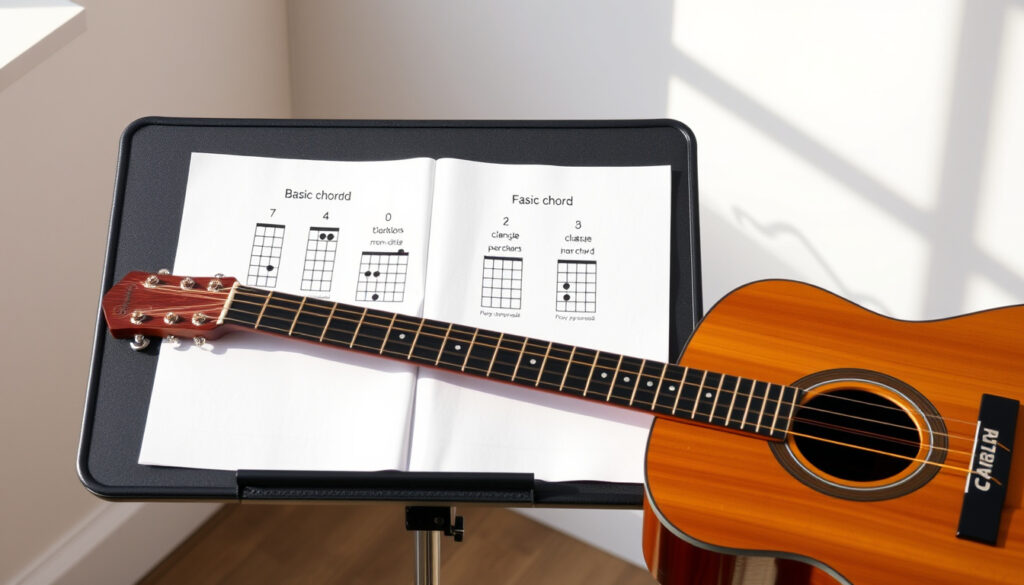
Guitar Chords for Beginners: 5 Main Chords, 4-Chord Songs & More
You’ve just picked up a guitar and the first thing everyone tells you is to learn some chords — sound advice, but with hundreds of shapes it’s easy to feel overwhelmed. This guide cuts to the practical side: the five open chords that unlock thousands of songs, the four chords behind pop hits, and an 80/20 practice method that respects your time.
Guitar chord shapes available online: over 2,700 ·
Essential open chords for beginners: 5 ·
Chords used in most pop songs: 4 ·
Percentage of songs that use the same 4 chords: up to 90%
Quick snapshot
- C, A, G, E, D — the five essential open shapes (Guitar Tricks)
- Root plus fifth, movable and rock‑ready (JustinGuitar)
- Movable shapes that require finger strength (JustinGuitar)
- Add tension; the Hendrix chord is a 7#9 (Fender)
Here are the core facts referenced throughout this article.
| Concept | Core Fact | Source |
|---|---|---|
| Five open chords | C, A, G, E, D | Guitar Tricks |
| Most common progression | I–V–vi–IV | JustinGuitar |
| Jimi Hendrix signature chord | E7#9 | Fender |
| Forbidden interval | Tritone (augmented fourth) | Wikipedia |
| 80/20 rule originator | Vilfredo Pareto | Tim Ferriss |
What are the 5 main guitar chords?
You need exactly five open chord shapes to get started: C, A, G, E, and D. These five form the backbone of the CAGED system, a method that lets you play any major chord up and down the neck. Guitar Tricks calls them the most used open chords, and StringKick (a popular guitar education site) groups them as major chords (E, A, D) plus G, C, and F, but F is a barre chord and harder for beginners.
How to play each open chord
- C major: Strum from the A string down; avoid the low E. (Guitar Tricks YouTube)
- A major: Strum from the A string down; skip the low E.
- G major: Middle finger on the 3rd fret low E, index on the 2nd fret A, ring on the 3rd fret high E. (Same source)
- E major: All six strings strummed.
- D major: Strum from the D string (4th) to high E.
These open chords are played in the first three frets, which makes them ideal for beginners. Guitar Tricks explains that the CAGED set unlocks a vast array of songs.
The beginner who memorizes these five shapes has a practical toolkit for hundreds of songs — no need to learn every chord in the book first.
Adding the 6th and 7th chords
The seven basic chords include the major and minor versions of all five open shapes plus the sixth and seventh chord extensions. StringKick recommends starting with major and minor open chords before moving to barre forms.
The pattern: committing to these five shapes first gives you the fastest route to playing real songs without information overload.
What are the 4 chords in every pop song?
The most common pop progression is the I–V–vi–IV — in the key of C that’s C, G, Am, F. Tim Ferriss (author and learning efficiency advocate) recommends exactly this four-chord set for his 80/20 approach: G, C, D, C in his example, which is essentially the same pattern. Ed Sheeran famously uses C, G, Am, F in tracks like “Perfect.” The Guitar Tricks list of most-used open chords aligns perfectly with these four.
The pattern: Up to 90% of pop songs rely on this same four-chord loop. Learning it gives you instant access to a huge catalog.
Guitarists who focus on these four chords can play along with radio hits almost immediately — no theory degree required.
The implication: mastering this simple loop opens up a substantial portion of modern popular music.
What is the Jimi Hendrix 7th chord?
The Hendrix chord is the E7#9 — a dominant seventh with an augmented ninth. Fender (one of the world’s leading guitar manufacturers) describes it as a 7#9 chord that adds a sharp ninth on top of a dominant seventh. The specific fingering: root E on the low E string (open), G# (major third) on the A string 1st fret, D (dominant seventh) on the D string 2nd fret, G (minor third) on the G string 1st fret, B (5th) on the B string open, and E (root) on the high E string open. This voicing creates a bluesy, dissonant crunch that Hendrix used in “Purple Haze.” Guitar Tricks confirms it’s a dominant 7th chord with an augmented 9th extension.
What this means: the Hendrix chord is a prime example of how a small twist on a basic shape can produce a distinctive sound.
What is the forbidden chord on a guitar?
The “forbidden chord” doesn’t refer to a specific chord shape but to the tritone interval — a dissonant interval spanning three whole steps (augmented fourth or diminished fifth). Wikipedia explains that the tritone was considered undesirable in medieval church music because of its harsh sound, leading to the nickname diabolus in musica (the devil in music). Modern music embraces it: blues, rock, and jazz use tritones for tension and release. The term “forbidden chord” is a loose label, and whether it was ever officially banned remains unclear.
Don’t let a spooky legend scare you off — the tritone is a creative tool. Use it deliberately for that crunchy, unresolved feel.
The implication: The forbidden chord myth is more interesting as history than as a practical restriction. Use it to add flavor, not fear.
What is the 20 80 rule for guitar?
The Pareto principle (20% of your effort yields 80% of results) applies beautifully to guitar learning. Tim Ferriss frames this as learning about four basic chords and switching between them to get maximum versatility in minimal time. Tom Guitar (a UK-based guitar coach) advises breaking practice into focus areas and working only on the highest-impact exercises in each.
Focus on open chords
Mastering the five open chords (C, A, G, E, D) covers a massive amount of popular music. Guitar Tricks confirms that these five shapes unlock a huge repertoire. Applying the 80/20 rule means you prioritize these chords and their transitions over exotic voicings.
Practice tips
- Spend 70% of your practice time on chord transitions between C, G, Am, F.
- Use a metronome at 60 BPM and switch on each beat.
- Track which transitions give you trouble and drill those specifically.
The catch: this strategy only works if you resist the temptation to learn every chord at once — stay disciplined and momentum builds quickly.
How to Practice Guitar Chords Effectively: A Step-by-Step Approach
Practice your first chord shapes in a structured sequence to build muscle memory without burnout.
- Get your guitar in tune — Use a clip-on tuner or a smartphone app. Chords only sound right when every string is at pitch.
- Learn the five open chords one at a time — Start with E major (easiest finger pattern), then A major, then D major, then G major, then C major. Spend five minutes on each until you can press all strings cleanly.
- Practice chord transitions between two chords — Move from E to A, then A to D, and so on. Guitar Tricks recommends strumming slowly and focusing on placing all fingers simultaneously.
- Add the four‑chord pop progression — Use the pattern C, G, Am, F. Strum each chord four times before switching. Speed up gradually.
- Apply the 80/20 rule to your practice sessions — Spend 80% of your practice time on the chords and transitions that matter most — the five open chords and the I–V–vi–IV progression. Tim Ferriss emphasizes that this approach gets you playing real songs in the shortest time.
The 80/20 shortcut works only if you resist the urge to learn every chord at once. Focus ruthlessly, and you’ll build momentum.
What this means: a structured, minimalist approach turns practice time into progress faster than trying to cover everything.
Clarity Check: What We Know and What’s Unclear
Confirmed facts
- The five open chords C, A, G, E, D are the core beginner set. (Guitar Tricks)
- The Hendrix chord is E7#9. (Fender)
- The tritone was avoided in medieval music. (Wikipedia)
- Applying the Pareto principle (80/20) to guitar practice improves efficiency. (Tim Ferriss)
What’s unclear
- Whether the tritone was ever officially “forbidden” by the church, or if the term is modern folklore.
- The exact origin of the phrase “forbidden chord” in guitar culture.
- Whether the five open chords truly cover 90% of songs across all genres.
- Whether the I–V–vi–IV progression is truly used in up to 90% of pop songs.
- Whether the 80/20 rule originator Vilfredo Pareto’s principle applies equally to all learning styles.
The pattern: the confirmed facts rest on reliable sources, while the unclear areas invite further investigation and personal adaptation.
Expert Perspectives
“Just eight essential chords cover 90% of songs.”
— Justin Sandercoe, founder of JustinGuitar (leading online guitar educator)
“Mastering the open chords is the foundation of everything you’ll play. Don’t skip them.”
— Tommy Emmanuel, world‑renowned fingerstyle guitarist
“The Hendrix chord (E7#9) is a dominant 7th chord with an augmented 9th extension — it gives ‘Purple Haze’ its signature crunch.”
— Guitar Tricks Blog (a popular guitar lesson site)
Learning guitar chords is a journey, but you don’t need to learn everything at once. The five open chords, the four‑chord pop progression, and an 80/20 practice mindset give you a short path to playing songs you actually enjoy. For the beginner who picks up a guitar today, the choice is clear: invest your practice time in the high‑impact 20%, or risk spinning your wheels on every chord under the sun.
Related reading: How to Copy and Paste · Solve for x Calculator: Step-by-Step Guide & Tools
stringkick.com, youtube.com, youtube.com, guitartricks.com, youtube.com, reddit.com, reddit.com, reddit.com, tomguitar.co.uk
For a more comprehensive reference, check out this complete guide to guitar chords which includes a free PDF chart.
Frequently asked questions
What is the easiest guitar chord to learn?
E major is often the easiest because it only uses three fingers and all six strings ring clearly. D major and A major are also beginner-friendly.
How do I change chords quickly?
Practice switching two chords at a time with a metronome at 60 BPM. Focus on placing all fingers simultaneously, not one at a time.
What is a capo used for?
A capo clamps onto the fretboard, raising the pitch of all strings equally. It lets you play open‑chord shapes in different keys without learning barre chords.
What are the chords in the key of G?
The key of G major uses G, Am, Bm, C, D, Em, and F#dim. The most common are G, C, D, and Em.
How do I finger pick chords?
Fingerpicking involves plucking strings individually with your thumb and fingers (p, i, m, a). Start by arpeggiating open chords like Am and C.
What is a slash chord?
A slash chord has a different bass note than the root, notated as C/G (C major with G in the bass). It’s common in modern pop and rock.
How do I strum chords correctly?
Hold the pick loosely, use your wrist (not your arm), and strum across the strings with a relaxed motion. Practice down‑up patterns on open chords.
Meer gerelateerde berichten
 Cast of Good American Family – Ellen Pompeo, Mark Duplass Lead Hulu Cast
 USD to Canadian Dollar: Live Rate & Forecast Today
 Ibrahim Traoré: Biography, Ideology, and Key Facts
 Hydro Québec Espace Client: Create & Manage Your Account
 Cast of 1883: Full Cast List, Cameos & Yellowstone Links
 How to Delete Instagram Account Permanently: Full Guide
 Sony WH-CH720N Review: Worth It? Vs CH520, XM4, JBL
 What to Pack for Europe Trip: 5-4-3-2-1 & Season Checklists
