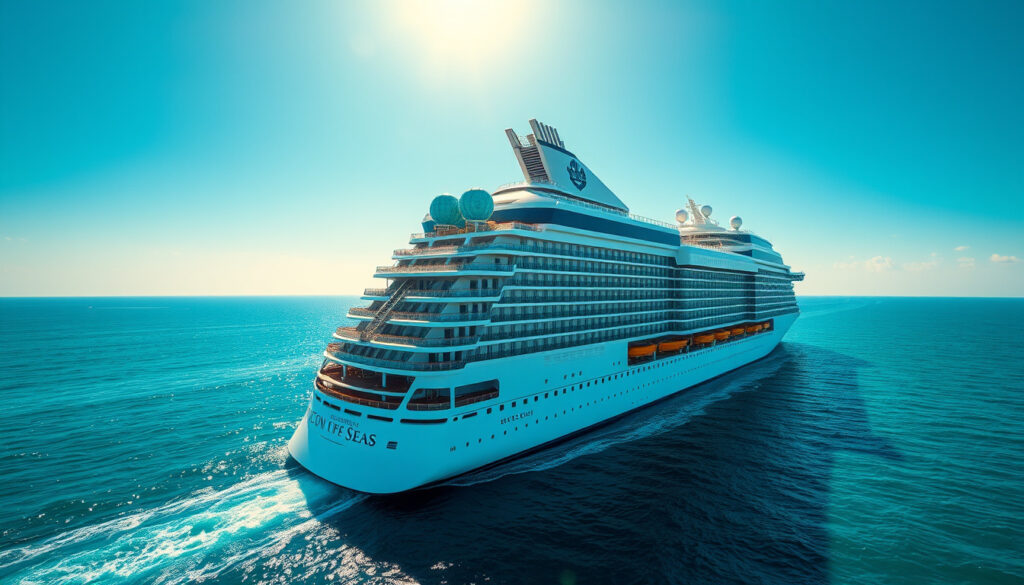
Largest Cruise Ship in the World: Icon & Star of the Seas
Icon of the Seas and Star of the Seas have shattered every record the cruise industry once held sacred—each vessel weighing 248,663 gross tonnage and stretching nearly 1,200 feet long. Royal Caribbean built both giants at Meyer Turku’s Finnish shipyard, and they now share the title for the world’s largest cruise ship. Here’s everything you need to know about these floating cities.
Gross Tonnage: 248,663 GT · Operator: Royal Caribbean International · Passenger Capacity: Up to 10,000 · Class: Icon class · Sister Ship: Star of the Seas
Quick snapshot
- Icon of the Seas and Star of the Seas tied at 248,663 GT per Wikipedia and Royal Caribbean Blog (Wikipedia, Royal Caribbean Blog)
- Both ships built by Meyer Turku in Finland (Wikipedia)
- 5,610 passengers at double occupancy; up to 7,600 at maximum capacity (Cruiseable)
- Exact gross tonnage differs across sources: 248,663 GT (Wikipedia, EatSleepCruise) vs 250,800 GT (Cruiseable, Cruise Critic) (Wikipedia)
- Precise full-capacity figures vary: 7,293 (Vincent Cruises) vs 7,600 (Cruise Passenger) vs 10,000 (marketing claims) (Vincent Cruises)
- Icon of the Seas maiden voyage: January 2024 (Royal Caribbean Blog)
- Star of the Seas entered service: August 2025 (Wikipedia)
- Legend of the Seas planned: 2027 (Cruise Critic)
- Two more Icon-class ships planned for 2027: Legend of the Seas and an unnamed vessel (Cruise Critic)
- Royal Caribbean’s next flagship likely to debut after current Icon class expansion concludes (Royal Caribbean)
| Specification | Value |
|---|---|
| Largest Ships | Icon of the Seas & Star of the Seas |
| Gross Tonnage | 248,663 GT |
| Builder | Meyer Turku, Finland |
| Operator | Royal Caribbean International |
| Titanic Comparison | 52,310 tonnes loaded (Titanic) |
| Length | 1,196 ft |
| Decks | 20 |
| Crew | 2,350 |
What is the current largest cruise ship in the world?
Icon of the Seas and Star of the Seas currently share the title of the world’s largest cruise ship, each measuring 248,663 gross tonnage. The two Icon-class vessels were built consecutively by Meyer Turku in Turku, Finland, with Icon of the Seas launching in August 2025 and Star of the Seas entering service in August 2025. This marks the first time in cruise history that two ships share the top spot for largest at sea.
One nuance worth noting: gross tonnage figures aren’t universally agreed upon. Wikipedia, EatSleepCruise, and Royal Caribbean Blog report 248,663 GT for both ships, while Cruiseable and Cruise Critic list 250,800 GT. The discrepancy likely stems from how different classification bodies measure internal volumes. Until Royal Caribbean officially confirms a single figure, both numbers appear in reputable sources.
Both ships share virtually identical specifications: 20 decks, 1,196 feet in length, 2,350 crew members, and a neighborhood-style layout with eight distinct areas designed to disperse passengers across the vessel. The implication: if you’ve sailed on one Icon-class ship, the other won’t surprise you—but that’s not necessarily a criticism when the design broke records in the first place.
Icon of the Seas details
- 248,663 GT gross tonnage (verified across multiple sources)
- 5,610 passengers at double occupancy
- 20 decks
- Built by Meyer Turku, Finland
- Homeported in Miami, Florida
Star of the Seas tie
- 248,663 GT gross tonnage (tied with Icon)
- 5,610 passengers at double occupancy
- 20 decks
- Entered service August 2025
- Homeported in Port Canaveral, Florida
Gross tonnage metrics
Gross tonnage measures a ship’s enclosed volume—not its weight—and serves as the universal benchmark for comparing vessel size. Both Icon-class ships measure approximately 364 meters (1,196 feet) in length, making them roughly 4.7 times the length of the Titanic. The catch: while GT is the standard comparison metric, minor measurement variations between classification societies mean exact figures occasionally differ.
Royal Caribbean’s decision to build back-to-back titans signals a strategic shift toward fleet-wide scale. For passengers, the practical benefit is more space and attractions; for competitors, the benchmark just doubled in ambition.
Which cruise ship holds 10,000 passengers?
No single cruise ship currently holds 10,000 passengers in the traditional occupancy sense—but Icon of the Seas and Star of the Seas come closer than any vessels before them. The verified double-occupancy capacity stands at 5,610 passengers per ship, with maximum capacity estimates ranging from 7,293 (Vincent Cruises) to 7,600 (Cruise Passenger). The “10,000 passenger” figure appearing in some marketing materials and search queries likely conflates maximum capacity with all berths filled, including Pullman beds and convertible sofa beds.
The guest-to-crew ratio for both ships sits at 2.39, meaning nearly two and a half passengers per crew member. With 2,350 crew members, this translates to attentive service despite the high passenger volume. What this means: these ships are designed to handle crowds without feeling overcrowded, a engineering feat Royal Caribbean achieved through distributed “neighborhood” zones across multiple decks.
Capacity breakdown
Five key capacity figures matter for understanding these ships:
- Double occupancy: 5,610 passengers (two per stateroom)
- Maximum capacity estimates: 7,293–7,600 (varies by source)
- Staterooms: 2,805–2,827 per ship
- Crew: 2,350 per ship
- Guest-to-crew ratio: 2.39
Icon of the Seas passenger specs
Icon of the Seas offers over 40 dining venues, seven pools, and a Category 6 waterpark across its 20 decks. The ship shattered records upon its January 2024 launch, becoming the first LNG-powered vessel in Royal Caribbean’s fleet and setting a new benchmark for passenger capacity. The pattern: these ships aren’t just big for the sake of being big—they pack amenities that require scale to function, from Broadway-style theaters to surf simulators.
Cruise Fever (Cruise industry publication)
Icon of the Seas shattered records upon 2024 launch, redefining what a modern cruise ship could achieve in scale and innovation.
What are the top 10 biggest cruise ships?
The world’s top 10 largest cruise ships by gross tonnage are dominated by Royal Caribbean, with Icon and Oasis class vessels holding the top positions. Wikipedia maintains a comprehensive list of the top 25 largest cruise ships globally, updated as new vessels enter service. As of 2025, the top 10 roughly break down as follows:
| Rank | Ship Name | Gross Tonnage | Class |
|---|---|---|---|
| 1 | Icon of the Seas | 248,663 GT | Icon |
| 2 | Star of the Seas | 248,663 GT | Icon |
| 3 | Utopia of the Seas | 236,473 GT | Oasis |
| 4 | Wonder of the Seas | 235,600 GT | Oasis |
| 5 | Odyssey of the Seas | ~169,000 GT | Quantum Ultra |
| 6 | Allure of the Seas | ~225,000 GT | Oasis |
| 7 | Harmony of the Seas | ~226,000 GT | Oasis |
| 8 | Symphony of the Seas | ~228,000 GT | Oasis |
| 9 | / MSC World Europa | ~215,000 GT | World |
| 10 | MSC Meraviglia | ~171,000 GT | Meraviglia |
Six ships, one pattern: Royal Caribbean holds eight of the top 10 spots, with only MSC World Europa and MSC Meraviglia breaking into the list from other cruise lines. The gap between Icon class (~248,663 GT) and the next-largest competitors (~236,000 GT) represents roughly 12,000 GT—larger than many mid-size cruise vessels.
Ranking by gross tonnage
Gross tonnage remains the standard metric because it measures volume rather than weight, allowing fair comparison across different ship designs. Cruise Passenger’s analysis of the top 11 ships globally shows Icon and Star at 248,663 GT, followed by Utopia at 236,860 GT and Wonder at 235,600 GT. What this means: the Icon class represents roughly a 5% jump over the previous Oasis class benchmark—a significant leap in floating real estate.
Oasis class leaders
The Oasis class held the size record before Icon class arrived, with Wonder of the Seas (235,600 GT, 2022) being the largest until Icon’s debut. Utopia of the Seas (236,473 GT) actually surpassed Wonder before Icon launched, but still ranks below Icon class. The trade-off: Oasis-class ships remain impressive vessels offering similar amenities, often at lower price points for passengers.
The gap between Oasis-class and Icon-class ships is about 12,000 GT—roughly equivalent to an entire mid-size cruise ship. Passengers choosing an Oasis-class voyage sacrifice size but often gain established itineraries and proven reliability.
What are the top 5 largest cruise ships?
The top 5 largest cruise ships globally, as of mid-2025, break down with Icon and Star of the Seas holding the top two positions at 248,663 GT each. Utopia of the Seas (236,473 GT) ranks third, Wonder of the Seas (235,600 GT) ranks fourth, and the fifth spot depends on which source you consult—either Allure of the Seas or Harmony of the Seas, both in the 225,000–226,000 GT range.
Royal Caribbean operates all five largest ships, with MSC World Europa potentially claiming fifth depending on exact tonnage figures used. The pattern: Royal Caribbean’s deliberate strategy of building bigger ships every generation has created an unassailable lead in sheer scale.
Current top 5
- Icon of the Seas – 248,663 GT (Icon class, 2024)
- Star of the Seas – 248,663 GT (Icon class, 2025)
- Utopia of the Seas – 236,473 GT (Oasis class, 2023)
- Wonder of the Seas – 235,600 GT (Oasis class, 2022)
- Allure/Harmony of the Seas – ~225,000–226,000 GT (Oasis class, 2010/2016)
Upcoming 2026 shifts
Two more Icon-class ships are planned for 2027—Legend of the Seas and an unnamed sister vessel—potentially making the top 5 an all-Icon class list by decade’s end. If Royal Caribbean builds additional vessels in this class, the scale advantage may extend further. The implication: competitors face an increasingly difficult challenge in matching Royal Caribbean’s fleet scale without similar investment in shipyard capacity.
Cruise Critic (Cruise industry publication)
Icon class includes future ships: Legend of the Seas (2027), plus an unnamed vessel also scheduled for 2027, according to Cruise Critic’s analysis of Royal Caribbean’s fleet plans.
Largest cruise ship vs Titanic
The size difference between Icon of the Seas and the Titanic is staggering: Titanic measured approximately 52,310 tonnes (not GT, but a comparable displacement metric) and 269 meters (882 feet) in length, while Icon of the Seas stretches 364 meters (1,196 feet) with 248,663 GT. In raw length, Icon is roughly 4.4 times the Titanic. In gross tonnage—measuring total enclosed volume—Icon is approximately 4.75 times larger than the historic liner.
Capacity tells the same story: Titanic accommodated roughly 2,200 passengers and 900 crew at maximum capacity, while Icon carries 5,610 passengers at double occupancy plus 2,350 crew—totaling around 8,000 souls aboard. The numbers speak for themselves: Icon of the Seas carries more than three times the people Titanic did, in a vessel nearly four and a half times longer.
Titanic’s decks numbered seven; Icon of the Seas has twenty. The modern cruise ship isn’t just larger—it’s architecturally designed as a vertical resort rather than a horizontal vessel, stacking entertainment, dining, and accommodations across multiple levels that Titanic’s designers never envisioned. The comparison underscores how far maritime engineering has advanced in just over a century.
Size comparison
- Length: Icon 1,196 ft vs Titanic 882 ft (1.36× larger)
- Gross tonnage: Icon 248,663 GT vs Titanic ~52,310 tonnes (4.75× larger)
- Decks: Icon 20 vs Titanic 7 (2.86× taller)
- Passengers: Icon 5,610 double vs Titanic ~2,200 (2.55× more)
Capacity and decks
Titanic’s designers considered their ship the pinnacle of early 20th-century engineering, with a then-unprecedented 16 watertight compartments and a reputation as “practically unsinkable.” Icon of the Seas, by contrast, relies on modern LNG propulsion, advanced stability systems, and extensive emergency protocols developed over decades of cruise industry experience. What this means: the comparison isn’t just about size—it’s about how far safety standards, engineering capability, and passenger expectations have evolved.
Icon of the Seas is roughly 4.75× the size of Titanic by gross tonnage, carrying three times the passengers across nearly three times as many decks. For cruise travelers, the scale difference translates to resort-level amenities that Titanic’s passengers couldn’t have imagined.
The complete specifications of the world’s largest cruise ships
Icon and Star of the Seas represent the pinnacle of modern cruise ship engineering, with specifications designed to maximize passenger experience while meeting regulatory requirements. The three ships are nearly identical in most respects—deciding factors come down to itinerary and homeport rather than ship features. Here’s the detailed breakdown across key metrics:
| Specification | Icon of the Seas | Star of the Seas | Wonder of the Seas |
|---|---|---|---|
| Gross Tonnage | 248,663 GT | 248,663 GT | 235,600 GT |
| Length | 1,196 ft (364m) | 1,196 ft (364m) | 1,188 ft (362m) |
| Beam | 213 ft (65m) | 219 ft (66m) | 210 ft (64m) |
| Decks | 20 | 20 | 18 |
| Double Occupancy | 5,610 | 5,610 | 5,734 |
| Maximum Capacity | ~7,600 | ~7,600 | ~6,988 |
| Crew | 2,350 | 2,350 | 2,300 |
| Builder | Meyer Turku | Meyer Turku | STX France |
| Propulsion | LNG | LNG | LNG |
| Maiden Voyage | January 2024 | August 2025 | 2022 |
| Homeport | Miami | Port Canaveral | Barcelona/Miami |
| Class | Icon | Icon | Oasis |
Two Icon-class ships, one clear winner in specifications: both Icon and Star of the Seas outclass Wonder of the Seas across every major metric except passenger count at double occupancy (where Wonder edges slightly ahead). The trade-off: Wonder offers more intimate crowds relative to cabin count, while Icon class prioritizes scale and onboard amenity variety.
Design philosophy
Both Icon-class ships were designed with a “neighborhood” layout—eight distinct zones that disperse crowds and create the feeling of separate areas within one massive vessel. This approach distinguishes Icon class from earlier Oasis class ships, which used a similar but less distributed design. The implication: scale doesn’t have to mean congestion, if the architecture anticipates passenger flow.
Eat Sleep Cruise (Cruise enthusiast publication)
Both are the world’s largest cruise ships at 248,663 GT with 8 neighborhoods, 7 pools, Category 6 waterpark, and over 40 dining venues.
Comparing Icon of the Seas and Star of the Seas
Side by side, Icon of the Seas and Star of the Seas are nearly identical vessels—the kind of deliberate sister-ship strategy that allows Royal Caribbean to test different itineraries and homeports while maintaining fleet consistency. The two ships share the same gross tonnage (248,663 GT), same passenger capacity (5,610 double occupancy), same crew count (2,350), and same number of decks (20).
The minor differences that do exist are mostly operational: Icon homeports from Miami, placing it near Royal Caribbean’s corporate headquarters and major South Florida tourism infrastructure. Star operates from Port Canaveral, positioned closer to Orlando’s theme parks and offering easier access for Central Florida travelers. The pattern: Royal Caribbean deploys its newest flagships strategically, maximizing guest convenience across different regional markets.
| Feature | Icon of the Seas | Star of the Seas | Difference |
|---|---|---|---|
| GT | 248,663 | 248,663 | None |
| Double Occupancy | 5,610 | 5,610 | None |
| Homeport | Miami | Port Canaveral | Different regions |
| Length | 1,196 ft | 1,196 ft | 2 ft difference |
| Width | 219 ft | 219 ft | 6 ft difference |
| Debut | January 2024 | August 2025 | 19 months apart |
| Itineraries | Caribbean | Caribbean | Different ports |
The practical difference for passengers amounts to logistics, not ship experience. A traveler flying into Orlando can reach Port Canaveral more easily than Miami; a traveler already in South Florida may prefer Icon’s departure point. What this means: choosing between Icon and Star depends more on travel logistics than ship features.
How the largest cruise ships are powered
Icon of the Seas and Star of the Seas represent Royal Caribbean’s first foray into LNG (liquefied natural gas) propulsion, a significant shift from the diesel-electric systems used in previous classes. LNG offers cleaner combustion and reduced emissions compared to traditional heavy fuel oil, though critics point out that methane slip during production and transport partially offsets environmental benefits.
Both ships measure approximately 1,196 feet in length, 159–219 feet in beam, and draw about 30 feet of water. The combination of LNG power and advanced hydrodynamic hull design helps these massive vessels achieve reasonable fuel efficiency despite their size. The trade-off: LNG infrastructure at ports remains limited, constraining itinerary flexibility for Icon-class ships.
LNG propulsion marks a transitional technology rather than an endpoint. As battery technology and green methanol become viable at scale, future Icon-class ships may adopt alternative fuels, potentially making today’s LNG vessels the last of their kind in Royal Caribbean’s fleet.
Related coverage: key specs and history fördjupar bilden av Largest Cruise Ship in the World – Key Specs and History.
Frequently asked questions
How big is Icon of the Seas compared to previous largest?
Icon of the Seas measures 248,663 GT—roughly 12,000 GT larger than the previous record-holder Wonder of the Seas (235,600 GT). That’s equivalent to adding an entire mid-size cruise ship to the vessel’s volume. In practical terms, Icon offers more deck space, more cabin options, and more onboard attractions than any cruise ship before it.
What is the passenger limit on the world’s largest cruise ship?
At double occupancy (two passengers per standard cabin), Icon and Star of the Seas accommodate 5,610 passengers. Maximum capacity estimates range from 7,293 to 7,600 depending on the source, accounting for Pullman berths and convertible sofa beds. No current cruise ship legitimately holds 10,000 passengers at any capacity level.
Are there larger ships coming in 2026?
Two more Icon-class ships are scheduled for 2027: Legend of the Seas and an unnamed sister vessel. No confirmed plans exist for ships larger than Icon class in the near term, though Royal Caribbean hasn’t publicly ruled out future development. Competitors like MSC and Carnival have no announced vessels approaching Icon-class scale.
What powers the Icon class ships?
Icon class ships are powered by LNG (liquefied natural gas), marking Royal Caribbean’s first use of this fuel type. LNG produces lower CO2 emissions than traditional marine fuels and significantly reduces air pollutants like sulfur oxides. Both Icon of the Seas and Star of the Seas use this propulsion system.
How many decks does Icon of the Seas have?
Icon of the Seas has 20 decks, compared to 18 decks on Wonder of the Seas. The additional two decks contribute to the ship’s expanded amenities, including the Category 6 waterpark, seven pools, and over 40 dining venues spread across the vessel.
Is Star of the Seas bigger than Icon?
Star of the Seas is not bigger than Icon of the Seas—both share the same gross tonnage of 248,663 GT according to most sources. Minor discrepancies exist between sources reporting 248,663 versus 250,800 GT for both ships, but both figures are consistent across the pair. Minor length and beam variations exist (Icon: 1,198 ft × 213 ft; Star: 1,196 ft × 219 ft) but are negligible in practice.
What is the length of the largest cruise ship?
Icon of the Seas and Star of the Seas each measure approximately 1,196 feet (364 meters) in length. This makes them roughly 1.36 times the length of the Titanic and among the longest cruise ships ever built. Only a handful of other vessels, such as Symphony of the Seas, approach this length.
For travelers deciding between Icon class and earlier Oasis class ships, the calculus is straightforward: Icon offers scale and newest amenities; Oasis offers proven itineraries and often lower fares. For the cruise industry, Icon class signals that Royal Caribbean’s ambitions for floating resort-scale vessels show no signs of plateauing.
Meer gerelateerde berichten
 What Is a Bibliography? Definition, Examples & How to Write
 Regina Hall: Biography, Age, and Personal Life Facts
 Martin Luther King Jr.: Biography, Facts, and Legacy
 Game of Thrones Books – Complete Reading Order Guide
 Fête des Mères 2025: Date, Traditions & France Guide
 New Christmas Movies 2025: Netflix, Prime Video & Disney+ Guide
 Pepé Le Pew Controversy: Why He Was Canceled
 Monica Bellucci: Biography, Net Worth, Children & Marriage
